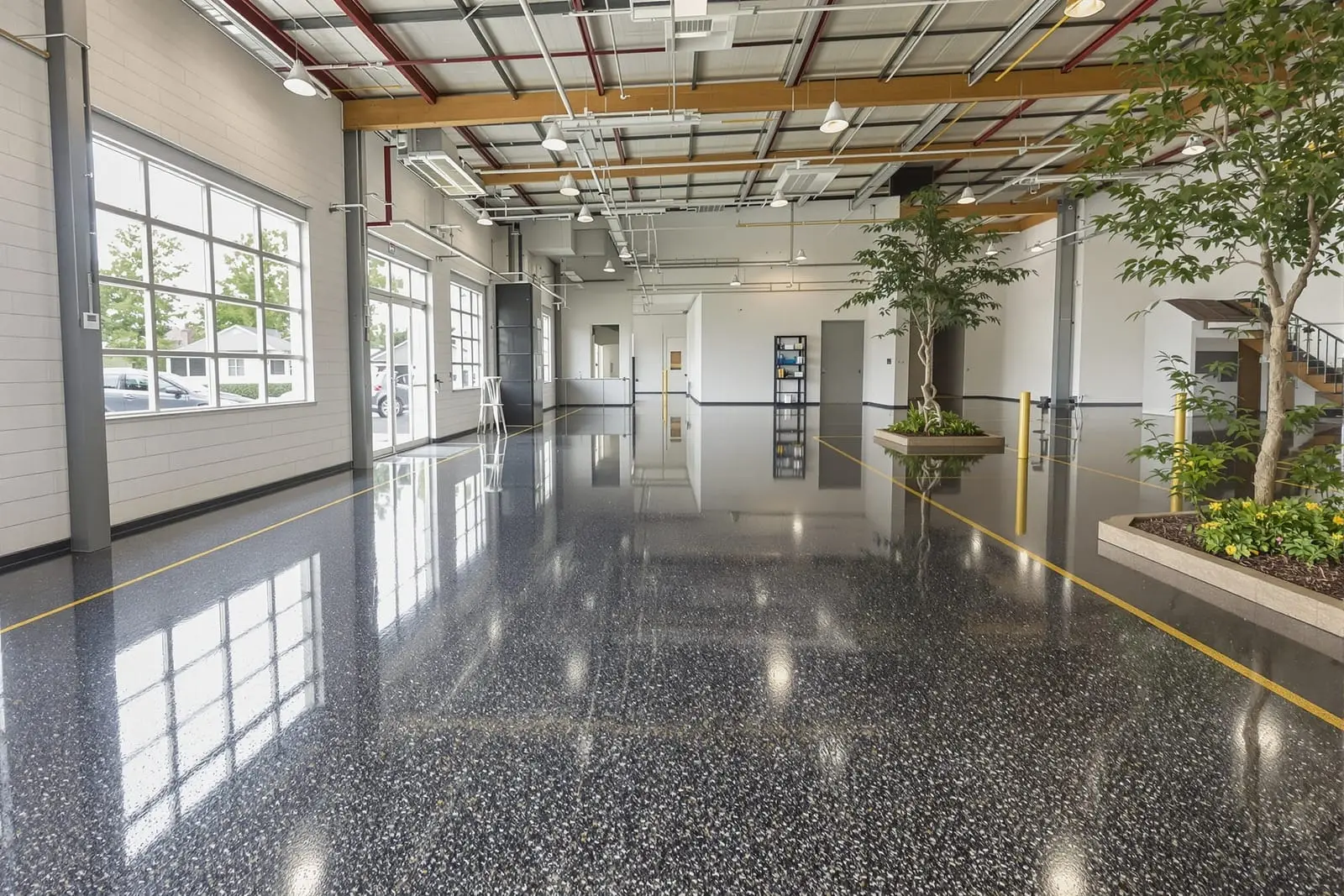
Support heavy equipment and storage with properly designed industrial concrete floors in Baton Rouge, LA. We pour and finish slabs for warehouses, shops, and production areas. Our team accounts for load requirements, flatness, and joint layout. Get a high performance floor that resists wear and keeps operations running smoothly.
Vanguard Concrete Baton Rouge provides professional industrial concrete floors throughout Baton Rouge, LA and the surrounding area. Our licensed, insured crew delivers safe, clean, on-time work with a free estimate before anything begins. Call (225) 416-8588 or request your free quote.
Industrial Concrete Floors Built for Baton Rouge Warehouses
If your warehouse or industrial space is in or around Baton Rouge, your concrete floor has to deal with more than just forklifts. Humidity, temperature swings, chemical spills, and constant traffic will expose any weakness fast. Vanguard Concrete Baton Rouge designs and installs industrial concrete floors that are planned around those specific local conditions, not a generic national spec.
We start by walking your facility with you. We look at your racking layout, forklift routes, dock locations, drainage points, and any areas that see point loads from heavy equipment or storage. We also ask about your operations: do you use narrow aisle lifts, reach trucks, or heavy dual‑drive forklifts, do you drag pallets, do you have wash‑down areas, do you expect future machinery moves. This is how we choose slab thickness, reinforcement type, and joint layout that actually fits how you use the building.
For many Baton Rouge warehouses, a 6 inch slab with reinforcing steel or dowel baskets at joints handles typical pallet racking and forklift traffic. Heavy manufacturing or high‑bay racking might need 7 or 8 inches or even thicker with higher strength concrete. We match the design to loading specs instead of guessing. If you have engineering drawings, we follow them closely. If you do not, Vanguard Concrete Baton Rouge can coordinate with structural engineers to get a stamped design that fits Baton Rouge permitting requirements and soil conditions.
How We Install Warehouse & Industrial Concrete Floors
A durable industrial floor starts below the surface. In our area, soil conditions can vary a lot, from harder clay near higher ground to softer, moisture‑sensitive soils in low spots. We begin with subgrade evaluation and preparation. That usually means stripping soft material, proof‑rolling to find weak areas, compacting, and bringing in a crushed stone or limestone base where needed. We aim for a uniform, well compacted base so the slab settles evenly and does not crack from inconsistent support.
Next, we set formwork and establish accurate elevations with laser levels. For bigger warehouses, we often use wet‑screed or laser screed systems to keep the slab flat across a large distance. Before any concrete arrives, we install vapor barriers when required (common over moisture sensitive flooring like epoxy or tile) and lay rebar, mesh, or place steel fibers as specified. On joints, we often use dowel baskets to carry wheel loads smoothly across sawcut or formed joints so forklifts do not hit bumps that shake operators and damage mast components.
When the ready‑mix trucks arrive, we check the delivery tickets for mix design, slump, and time. For industrial concrete floors we typically use a higher strength mix (often 4,000 PSI or more) with a low water‑cement ratio and sometimes add options like fibers or chemical admixtures to reduce shrinkage and curling. Vanguard Concrete Baton Rouge crews then place and strike off the concrete, use vibrating screeds or internal vibrators to consolidate around reinforcement, and power float the surface as it sets. Timing is critical in our humid climate, and our finishers pay close attention to how fast the surface is tightening up so we avoid issues like blistering or dusting.
After the initial float, we power trowel to the finish you choose, from a hard‑troweled smooth surface to a slightly textured finish for better traction. We mark and cut control joints at the right spacing and depth, usually the same day or early the next, to control where the slab will crack as it shrinks. Joints are then cleaned and later filled with semi‑rigid joint filler to protect edges from chipping under forklift traffic.
Finishes, Coatings, and Performance Options
Industrial concrete floors do not have to be plain gray. The right surface options can improve safety, cleanliness, and durability. Vanguard Concrete Baton Rouge offers a range of finishes and coatings that hold up in real warehouse conditions.
For distribution centers that move a lot of pallet jacks and forklifts, we often recommend a steel‑troweled hard finish with a chemical densifier. A densifier reacts with the concrete, making the surface harder and more resistant to dusting, so you spend less time fighting concrete dust on inventory and racks. We can also stain or lightly polish the floor to make it reflect more light, which can help improve visibility in racking aisles.
If you store chemicals, food products, or do any wash‑down cleaning, epoxy or urethane coatings can protect the slab from staining and chemical attack. We prepare the surface by grinding or shot blasting to get a good mechanical profile, then apply coatings in multiple layers, paying special attention to transitions at dock doors, drains, and thresholds. Slip‑resistant additives can be included in wet areas or where oil and grease are common.
Some Baton Rouge industrial clients need ESD (electrostatic dissipative) or conductive floors for electronics or specialized manufacturing. In those cases we coordinate with your equipment vendors to select coatings or toppings that meet resistance specs and integrate grounding points where they are needed. We also install colored striping, safety walkways, and forklift lanes directly into the coating system so your floor markings last much longer than paint alone.
If you expect future layout changes, we can design the original slab and coating system so you can remove anchor bolts, move lines, or adjust racking with minimal patching. That might mean specifying higher performance repair mortars from the start and planning joint patterns that match common racking bay sizes.
What Drives Cost and Schedule for Industrial Concrete Floors
Customers often ask why one quote for industrial concrete floors is higher than another. The total cost is driven by several factors, and understanding them helps you compare proposals fairly.
The biggest cost drivers are slab thickness, reinforcement type, and concrete mix design. A 6 inch fiber‑reinforced slab costs less than an 8 inch rebar grid with high strength concrete, but if your loads require the heavier design, cutting back will cost you far more in repairs later. Vanguard Concrete Baton Rouge walks you through these trade‑offs so you can see what is required, what is optional, and what is simply nice to have.
Access affects cost too. Pouring in an empty new shell is less expensive than replacing concrete in an active warehouse that has to stay partially operational. Working around existing racks or equipment, scheduling night or weekend pours, or phasing the work so you can keep shipping all add time and handling. We plan phasing with you so you keep your business moving while we work.
Moisture control and surface prep also influence both cost and timeline. In parts of Baton Rouge where groundwater is high or where there is no under‑slab vapor barrier, we sometimes need moisture mitigation steps before installing coatings or sensitive finishes. That can include grinding, applying moisture‑tolerant primers, or in severe cases installing special membranes or toppings. Skipping those steps can lead to blistered coatings or adhesive failures.
Weather and curing time matter for schedule. Industrial concrete needs proper curing so it reaches design strength and stays durable. We typically recommend at least 7 days before heavy forklift traffic on new slabs, sometimes more depending on loads and ambient conditions. In hot, humid months, we plan earlier morning placements and use curing compounds or wet curing methods to reduce rapid moisture loss at the surface. We will give you a clear timeline for light foot traffic, racking installation, and full operations so you can schedule crews and deliveries with confidence.
Common Warehouse Floor Problems and How We Prevent Them
Many of our calls in Baton Rouge involve fixing floors that were not designed or installed for industrial use. Common issues include wide, spalled joints that beat up forklifts, random cracks opening in the middle of aisles, low areas that collect water near dock doors, and surfaces that dust or peel under traffic.
To minimize joint problems, we design joint spacing and layout around your forklift patterns and rack rows, use proper sawcut timing and depth, and install load‑transfer devices like dowels. Once the concrete has cured, we use semi‑rigid fillers that protect joint edges but still allow controlled movement. This combination greatly reduces chipping and the vibration that operators feel when crossing joints.
Random cracking often comes from inconsistent base prep, poor joint layout, or improper curing. Vanguard Concrete Baton Rouge focuses heavily on subgrade compaction, uniform thickness, and early joint cutting. We also manage water content in the mix and curing practices to control shrinkage. While no slab is completely crack‑free, our goal is to keep cracks hairline and non‑structural so they do not affect your operations.
Drainage and flatness are another major concern for warehouse and industrial spaces. Uneven floors can cause mast sway in high‑bay racking and create trip hazards. Our crews use laser levels and, when appropriate, laser screeds to achieve the flatness tolerances specified for your project. At dock doors, we pay special attention to slope so water from rain or wash‑down does not pond inside the building.
If you already have a problem floor, we can often repair instead of fully replace. Options include joint rebuilds with semi‑rigid fillers and armoring, crack stitching with torque‑lock or similar systems, topping slabs, slab jacking or polyurethane lifting for settled areas, and full resurfacing with industrial toppings or coatings. We evaluate the current condition, your budget, and how long you plan to stay in the facility so we can recommend a repair approach that makes sense for your specific operation.
“
Professional warehouse & industrial concrete floors, done right the first time, quality materials, honest pricing, and results that last.
Vanguard Concrete Baton Rouge
Warehouse & Industrial Concrete Floors Across Our Service Area