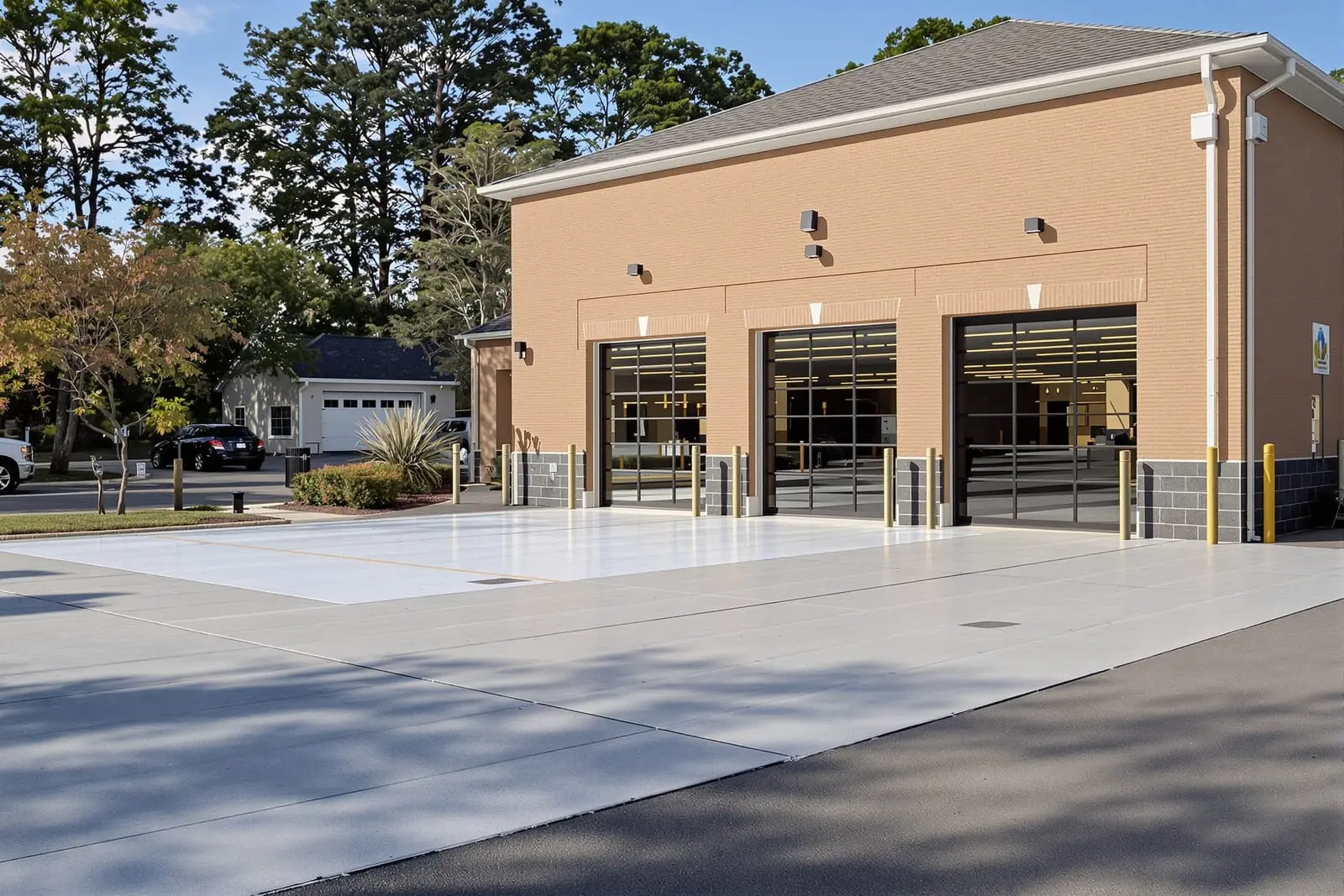
Support trucks and equipment with robust commercial concrete slabs in Baton Rouge, LA. We build loading docks, ramps, and pads that handle repeated heavy loads. Attention to reinforcement, thickness, and edge protection keeps slabs performing. Request a quote for new or upgraded loading dock concrete.
Vanguard Concrete Baton Rouge provides professional commercial concrete slab throughout Baton Rouge, LA and the surrounding area. Our licensed, insured crew delivers safe, clean, on-time work with a free estimate before anything begins. Call (225) 416-8588 or request your free quote.
Commercial Concrete Slabs Built for Baton Rouge Workloads
If you run a warehouse, plant, distribution center, or retail operation in Baton Rouge, the concrete under your equipment is not a small detail. A commercial concrete slab has to handle forklifts, pallet jacks, loaded trailers, and constant turning wheels without breaking down. Vanguard Concrete Baton Rouge designs and builds slabs and loading docks specifically for the way your facility actually works, not just what looks good on a print.
In our area, soil movement, high humidity, and heavy rain are real issues. We take the time to look at your site conditions, traffic patterns, and building use before we talk thickness or rebar. A light‑use retail storage room may be fine at 4 inches with fiber reinforcement, while a high‑bay warehouse with narrow aisle forklifts and rack legs can require 6 inches or more with rebar or wire mesh and proper joint layout. For loading docks that see 18‑wheelers daily, we often recommend thicker approach slabs, upgraded reinforcement, and stronger concrete mixes so you are not repairing edge breaks every year.
Every project starts with a walk‑through and simple questions. What are your heaviest loads and wheel types. How often are trucks docking. Do you use dock levelers, dock plates, or grade level loading. These answers drive the design. Our goal is straightforward: build a slab and dock system that fits your operation and Baton Rouge soil conditions so you are not dealing with cracks, spalling, and ponding water a couple of seasons later.
How We Design and Build Commercial Concrete Slabs
Good commercial slabs are planned on paper first. Vanguard Concrete Baton Rouge begins with subgrade evaluation. Around Baton Rouge, we see a mix of clay and fill, especially behind older buildings and along industrial corridors like Airline Highway and Choctaw. Soft or patched‑in areas are proof rolled and corrected. We remove unsuitable material, compact in lifts, and often add a crushed limestone or recycled concrete base to reduce settlement and keep moisture more consistent under the slab.
Next is slab thickness, reinforcement, and concrete mix. For many commercial floors and exterior slabs, we work in the 4 to 8 inch range. Forklift traffic, racking loads, and truck weights help determine the exact thickness. For reinforcement, we may use #4 or #5 rebar on a grid, welded wire mesh, or modern macro fibers in the concrete. On larger floors, a combination of fibers and steel often makes sense. Concrete mixes are typically 3,500 to 5,000 psi, sometimes higher for busy loading docks or waste transfer areas. We also look at air entrainment for exterior slabs to handle the occasional freeze.
Forms and layout come next. We set forms to proper elevation so water drains away from the building, not back toward roll‑up doors or dock pits. Vapor barriers may be installed under interior slabs, especially for buildings that will get epoxy, polished concrete, or tile. Expansion and control joints are planned so they land under future walls, at column lines, and away from high‑traffic turning points when possible. This joint planning is one of the biggest differences between a slab that stays clean and one that cracks in random patterns.
Once the concrete is placed, we strike off, bull float, and then finish based on your needs. Warehouse floors might get a smooth trowel finish for easy cleaning and fork travel. Exterior loading areas often get a broom finish for traction in the rain. Proper curing is built into our schedule. We keep the slab moist or use curing compounds so the surface does not dry too fast in our Louisiana heat, which can cause early cracking and dusting.
Loading Docks That Match Your Fleet and Site
Loading docks are more than just a raised pad. If they are not built to match your trucks, trailers, and dock equipment, you end up with broken concrete edges, unsafe slopes, and difficult loading. Vanguard Concrete Baton Rouge starts a dock project with measurements, not assumptions. We look at your typical trailer heights, yard slope, existing pavement, and whether you are using pit levelers, edge‑of‑dock levelers, or simple dock plates.
For raised docks, we form and pour a structural concrete platform that is tied into the building foundation or an independent footing system, depending on the building design. Dock faces are thickened and heavily reinforced because that front edge takes repeated impacts from trailer bumpers. We often recommend a higher strength concrete at the dock face and the truck approach, because this is where chipping and spalling usually start.
The truck approach slab is just as important as the dock itself. In Baton Rouge, many industrial sites have older asphalt yards or patched concrete. If the approach is soft or poorly drained, trucks will rock and stress the dock. We remove failed material, build a solid base, and pour a reinforced approach slab with the right slope so rainwater does not pool where forklift tires and workers are moving. We coordinate concrete elevations with your dock leveler installer or door contractor so lips and seals work correctly from day one.
Trip hazards and drainage are constant concerns. We set joint locations so trailer landing gear does not sit directly over slab edges, use rounded or armored edges where practical, and pay close attention to how runoff ties into your existing drainage. For food, pharmaceutical, or temperature‑controlled facilities, we can also discuss insulated dock details with your design team so the concrete interfaces properly with seals and enclosures.
What Drives Cost and How to Avoid Surprise Repairs
Commercial concrete slab pricing in Baton Rouge depends on more than square footage. The biggest cost drivers are slab thickness, reinforcement type, concrete strength, and subgrade preparation. A simple 4 inch storage slab on good native soil with fiber reinforcement will cost less per square foot than an 8 inch heavily reinforced dock slab on poor fill that needs excavation and base rock. Vanguard Concrete Baton Rouge walks you through these choices so you see exactly what you are paying for and why.
Poor soil or bad fill behind an older building can change the scope. If we hit soft spots during probing or proof rolling, we will explain the options: undercut and replace, use a thicker base, or adjust the design. Skipping this step to save a little up front often leads to settlement, cracking, and ponding that interrupts operations later. On expansions to existing warehouses along Florida Boulevard or in North Baton Rouge, we also pay attention to matching the new slab height and joint layout to the old so forklifts are not bouncing over mismatched transitions.
Reinforcement and joint detailing are another area where small cost decisions have big long‑term impact. Lighter wire mesh can be cheaper than rebar, but if you have concentrated rack legs or dock equipment bolts, we usually recommend a heavier rebar grid or dowel baskets at joints. For high traffic joints, installing load transfer dowels adds some upfront cost but significantly reduces faulting and uneven joints down the road. We explain where these upgrades really matter and where they do not so you can keep the budget under control without sacrificing performance.
Finishes and coatings also affect price. If you plan to install polished concrete, epoxy, or line striping for aisles and staging zones, the slab flatness and finishing standards need to be higher. We can pour to higher FF/FL tolerances for very narrow aisle systems or coordinate with your coating contractor to make sure the concrete profile is correct. Talking through these details before we pour reduces change orders and surface prep costs later.
What Baton Rouge Owners Should Decide Before Pour Day
You do not need to be a concrete expert, but coming into a project with a few decisions made will speed things up and reduce changes. Vanguard Concrete Baton Rouge usually asks owners and facility managers to clarify three main points before we finalize a commercial concrete slab or loading dock plan.
First, define how you expect to use the space in the next 5 to 10 years, not just this year. Are you planning to add heavier racking, different forklifts, or more truck traffic as your business grows. If so, it can be smarter to build a slightly thicker slab or stronger dock now instead of trying to reinforce it later around ongoing operations.
Second, think about drainage and cleanliness. Do you want exterior loading slabs pitched more aggressively to get water away fast, or do you need flatter areas for pallet stacking and material staging. Inside, will you be washing floors regularly or dealing with oils and chemicals. Those answers affect flatness, slope, joint sealant selection, and sometimes the choice between a simple broom finish and a slab intended for a coating or polish.
Third, consider timing and downtime. For active warehouses and distribution centers, we often break work into phases so you always have some doors open. Concrete needs curing time before it sees full traffic. We will lay out a schedule that shows when light foot traffic, forklifts, and trucks can safely return to each area so you can plan staffing and deliveries. Good communication here matters as much as good finishing.
If you are ready to upgrade or build new loading docks and commercial slabs anywhere in the Baton Rouge area, Vanguard Concrete Baton Rouge can walk your site, listen to how your operation runs, and give you a clear, detailed plan for concrete that holds up to real daily use.
“
Professional loading docks & commercial slabs, done right the first time, quality materials, honest pricing, and results that last.
Vanguard Concrete Baton Rouge
Loading Docks & Commercial Slabs Across Our Service Area